Best Cloud Hosting Providers Compared: AWS vs Azure vs Google Cloud in 2026
Best Cloud Hosting Providers Compared: AWS vs Azure vs Google Cloud in 2026
Cloud computing has become the backbone of modern businesses. Whether you’re running a small business website, an eCommerce store, a SaaS platform, or a large enterprise application, choosing the right cloud hosting provider can significantly impact your website’s speed, security, reliability, and operating costs.
In 2026, three companies continue to dominate the cloud hosting market: Amazon Web Services (AWS), Microsoft Azure, and Google Cloud Platform (GCP). Each offers world-class infrastructure, advanced security, scalable resources, and powerful AI capabilities. However, every platform has unique strengths that make it suitable for different types of users.
In this guide, we’ll compare AWS, Azure, and Google Cloud based on performance, pricing, security, scalability, AI features, and ease of use to help you choose the best cloud hosting provider for your needs.
What Is Cloud Hosting?
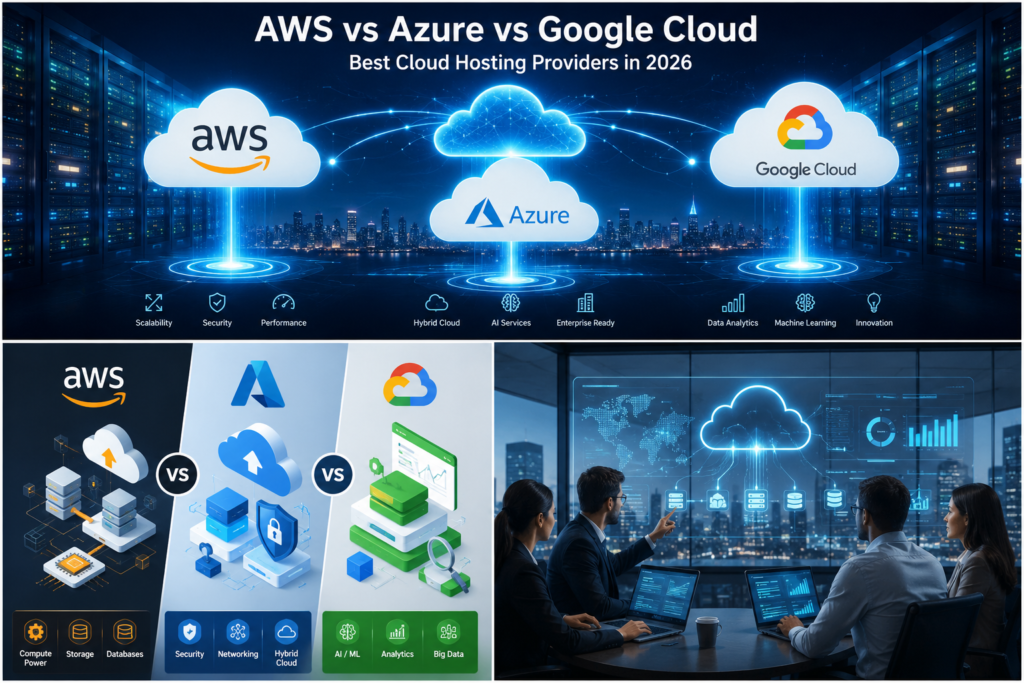
Cloud hosting is a web hosting solution that stores your website or application across multiple interconnected servers instead of relying on a single physical server. This approach provides higher reliability, better performance, automatic scalability, and improved uptime.
Unlike traditional hosting, cloud hosting allows businesses to increase or decrease computing resources based on demand. This flexibility makes it ideal for businesses expecting growth or handling fluctuating traffic.
Benefits of Cloud Hosting
- High availability and uptime
- Faster website performance
- Automatic scalability
- Enhanced security
- Pay-as-you-go pricing
- Easy disaster recovery
- Global content delivery
Amazon Web Services (AWS)
Amazon Web Services is the world’s largest cloud computing platform and has been a leader in the industry for many years. AWS offers more than 250 cloud services, including computing, storage, networking, artificial intelligence, databases, analytics, and security.
Many global companies trust AWS because of its mature ecosystem, extensive documentation, and reliable infrastructure.
Key Features
- Amazon EC2 virtual servers
- Amazon S3 cloud storage
- Amazon RDS managed databases
- AWS Lambda serverless computing
- CloudFront CDN
- Amazon Bedrock AI services
Pros
- Largest global infrastructure
- Excellent reliability
- Wide range of cloud services
- Enterprise-grade security
- Strong developer community
- Highly scalable
Cons
- Pricing can be difficult to understand
- Learning curve for beginners
- Cost management requires careful monitoring
Best For: Large enterprises, SaaS companies, developers, and businesses requiring maximum scalability.
Microsoft Azure
Microsoft Azure is one of the fastest-growing cloud platforms, especially among organizations already using Microsoft products. Azure integrates seamlessly with Microsoft 365, Windows Server, SQL Server, and Active Directory, making it a preferred choice for enterprise customers.
Azure also offers powerful hybrid cloud capabilities, allowing businesses to combine on-premises infrastructure with cloud services.
Key Features
- Azure Virtual Machines
- Azure SQL Database
- Azure Blob Storage
- Azure Kubernetes Service
- Azure AI Services
- Microsoft Defender Security
Pros
- Excellent Microsoft integration
- Strong hybrid cloud support
- Enterprise-level security
- Global network of data centers
- Comprehensive compliance certifications
Cons
- Some services can be complex for beginners
- Pricing varies depending on workloads
- Advanced features may require Microsoft expertise
Best For: Enterprises, government organizations, healthcare providers, and businesses using Microsoft technologies.
Google Cloud Platform (GCP)
Google Cloud Platform has become a favorite among developers, startups, and AI-focused businesses. Powered by Google’s global network, GCP delivers excellent performance, low latency, and industry-leading artificial intelligence tools.
Google Cloud is particularly well-known for BigQuery, Vertex AI, and Google Kubernetes Engine (GKE).
Key Features
- Compute Engine
- Google Cloud Storage
- BigQuery
- Vertex AI
- Google Kubernetes Engine
- Cloud CDN
Pros
- Excellent AI and machine learning tools
- Developer-friendly platform
- Competitive pricing
- Fast global network
- Strong data analytics capabilities
Cons
- Smaller ecosystem than AWS
- Fewer enterprise services than Azure
- Less extensive third-party marketplace
Best For: Startups, AI companies, developers, and data-driven businesses.
AWS vs Azure vs Google Cloud Comparison
| Feature | AWS | Azure | Google Cloud |
|---|---|---|---|
| Global Infrastructure | ⭐⭐⭐⭐⭐ | ⭐⭐⭐⭐⭐ | ⭐⭐⭐⭐☆ |
| Performance | ⭐⭐⭐⭐⭐ | ⭐⭐⭐⭐⭐ | ⭐⭐⭐⭐⭐ |
| Security | ⭐⭐⭐⭐⭐ | ⭐⭐⭐⭐⭐ | ⭐⭐⭐⭐⭐ |
| AI & Machine Learning | ⭐⭐⭐⭐☆ | ⭐⭐⭐⭐☆ | ⭐⭐⭐⭐⭐ |
| Ease of Use | ⭐⭐⭐⭐☆ | ⭐⭐⭐⭐☆ | ⭐⭐⭐⭐⭐ |
| Hybrid Cloud | ⭐⭐⭐⭐☆ | ⭐⭐⭐⭐⭐ | ⭐⭐⭐⭐☆ |
| Pricing Simplicity | ⭐⭐⭐☆☆ | ⭐⭐⭐⭐☆ | ⭐⭐⭐⭐⭐ |
Pricing Comparison
Pricing is one of the biggest factors when choosing a cloud provider.
AWS follows a pay-as-you-go model with a wide variety of pricing options. While flexible, costs can increase quickly if resources are not monitored.
Azure also uses pay-as-you-go pricing and offers discounts for organizations already using Microsoft software licenses.
Google Cloud is known for transparent pricing and automatic sustained-use discounts, making it attractive for startups and businesses looking to control costs.
Security Comparison
Security is a top priority for all three providers.
AWS offers Identity and Access Management (IAM), encryption, DDoS protection, and advanced monitoring tools.
Azure provides Microsoft Defender, Azure Active Directory, Key Vault, and extensive compliance certifications.
Google Cloud includes Identity-Aware Proxy, Cloud Armor, Confidential Computing, and Zero Trust security architecture.
All three providers meet high international security standards and are trusted by businesses worldwide.
Which Cloud Provider Should You Choose?
The best cloud provider depends on your specific requirements.
Choose AWS if you need the largest cloud ecosystem, extensive services, and global scalability.
Choose Microsoft Azure if your business relies heavily on Microsoft products or requires hybrid cloud solutions.
Choose Google Cloud if you’re focused on artificial intelligence, machine learning, big data analytics, or startup-friendly pricing.
Final Verdict
There is no one-size-fits-all solution when it comes to cloud hosting. AWS remains the overall market leader thanks to its massive infrastructure and broad service portfolio. Microsoft Azure is the best choice for enterprises already invested in Microsoft’s ecosystem, while Google Cloud stands out for innovation in AI, analytics, and developer tools.
Before selecting a provider, consider your business goals, technical expertise, expected growth, and budget. Choosing the right cloud platform today can improve performance, reduce costs, strengthen security, and support future expansion.
Whether you’re launching your first website or managing enterprise applications, AWS, Azure, and Google Cloud all provide reliable cloud hosting solutions capable of meeting modern business demands in 2026.